
What Is 3-Axis, 4-Axis, and 5-Axis Machining?
3-axis, 4-axis, and 5-axis machining refer to different levels of CNC machine motion used to manufacture precision components. Each configuration adds additional axes of movement, allowing the cutting tool or workpiece to approach the part from more directions.
3-axis machining moves along the X, Y, and Z linear axes.
4-axis machining adds a rotational axis, allowing the part to rotate for additional feature access.
5-axis machining adds a second rotational axis, enabling simultaneous multi-directional machining of complex geometries.
As the number of axes increases, the machine’s ability to produce intricate features, compound angles, and multi-surface parts in fewer setups also increases.
In precision manufacturing environments, selecting the appropriate axis configuration is critical for balancing part complexity, accuracy, efficiency, and cost.
How 3-Axis, 4-Axis, and 5-Axis Machining Work
Each axis configuration follows a CNC-controlled workflow:
- CAD models define geometry and tolerance requirements.
- CAM software generates toolpaths based on available axes.
- 3-axis machines machine from fixed orientations.
- 4-axis machines rotate the part to access additional features.
- 5-axis machines dynamically reposition the tool and part during cutting.
Higher axis capability reduces part repositioning and improves dimensional accuracy.
Key Elements of Multi-Axis Machining
- CNC machining centers with varying axis configurations
- Rotary and tilting axes for additional motion
- Advanced CAM programming for multi-axis toolpaths
- Precision cutting tools
- Rigid fixturing and workholding
- Precision inspection and measurement systems
Multi-Axis Machining in Aluminum Forging
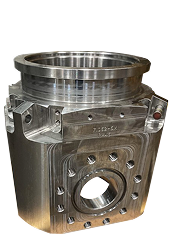
Multi-axis machining is widely used to finish forged aluminum components. Forging provides near-net shape strength, while multi-axis machining enables complex geometry refinement.
Anchor Harvey applies 3-axis, 4-axis, and 5-axis machining to:
- Machine forged components with complex surface features
- Reduce setup changes and alignment errors
- Maintain tight tolerances on multi-surface parts
- Improve surface quality and dimensional consistency
- Support high-performance structural and mechanical applications
The appropriate axis configuration is selected based on part geometry, tolerance requirements, and production efficiency.
Industry Applications
Aerospace
Multi-axis machining supports aerospace components with complex geometries, compound angles, and strict tolerance requirements.
Specialty Automotive
Specialty automotive manufacturers rely on multi-axis machining for performance components requiring precise geometry and lightweight design.
Motorsports
Motorsports applications use multi-axis machining to produce high-precision, lightweight components with advanced geometric profiles.
Heavy Equipment, Construction, and Agriculture
Multi-axis machining enables the accurate production of complex components used in heavy-duty machinery.
Fluid Power
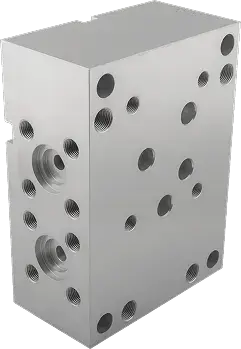
Fluid power systems use multi-axis machining to create valve bodies, manifolds, and housings with internal passages and tight tolerances.
Energy
Energy sector applications depend on multi-axis machining for components requiring complex geometry and high structural integrity.
Why 3-Axis, 4-Axis, and 5-Axis Machining Matter
- Enable progressively greater geometric capability
- Reduce setup time and alignment errors
- Improve dimensional accuracy and surface quality
- Support complex and high-performance components
- Increase manufacturing efficiency and consistency
Learn More About 3-Axis, 4-Axis, and 5-Axis Machining
Interested in learning how multi-axis machining supports high-performance aluminum component manufacturing? Connect with Anchor Harvey to explore our expertise in precision forged and machined aluminum solutions.high performance end-to-end manufacturing.
No Matter the Industry,
We Flex to Solve What You Need
No Matter
the Industry,
We Are Part of
Everything You do.