
What Is 5-Axis CNC Machining?
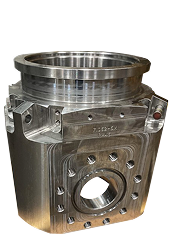
5-axis CNC machining is an advanced machining process in which cutting tools move along five different axes simultaneously to produce complex, high-precision components. In addition to the traditional linear X, Y, and Z axes, the machine incorporates two rotational axes that allow the tool or workpiece to approach the part from multiple angles.
This added range of motion enables manufacturers to machine intricate geometries, deep cavities, and compound angles in a single setup. As a result, 5-axis CNC machining improves accuracy, reduces setup time, and enhances surface quality compared to conventional multi-axis machining methods.
In precision manufacturing environments, 5-axis CNC machining is used for components that require exact geometry, tight tolerances, and consistent repeatability.
How 5-Axis CNC Machining Works
The machining process follows a digitally controlled workflow:
- CAD models define complex geometries and tolerance requirements.
- CAM software generates synchronized tool paths across five axes.
- The CNC machine positions the tool and part dynamically during cutting.
- Multiple surfaces are machined in a single setup.
- Finished parts are inspected to verify dimensional accuracy and surface integrity.
By machining multiple faces at once, 5-axis CNC machining minimizes repositioning errors and improves overall precision.
Key Elements of 5-Axis CNC Machining
- 5-axis CNC machining centers
- Rotary and tilting axes for multi-directional movement
- Advanced CAM software for multi-axis tool path generation
- High precision cutting tools
- Rigid workholding and fixturing systems
- Precision inspection and measurement equipment
5-Axis CNC Machining and the Design-to-Production Lifecycle
One of the less obvious benefits of 5-axis CNC machining is what it makes possible at the design stage. When engineers know that 5-axis capability is available downstream, they can design components with more efficient geometries, consolidating features, reducing part count, and optimizing load paths, without being constrained by the limitations of conventional three-axis setups.
This is a meaningful example of how manufacturing capability and design decisions interact across the lifecycle. The equipment available at the machining stage should inform what is designed, not simply respond to it.
Single-setup machining also has direct implications for dimensional integrity. Every time a part is repositioned between setups, there is an opportunity for datum shift, a small but cumulative source of variation that compounds across features. By completing complex geometry in one setup, 5-axis machining removes several of those opportunities. In a high-tolerance application, this is not a minor efficiency gain. It is a meaningful contribution to the accuracy of the finished part and to the repeatability of that accuracy across a production run.
That said, 5-axis capability does not eliminate the influence of upstream decisions. A complex forged or formed blank that arrives at the machining stage with inconsistent geometry still presents challenges that five axes of motion cannot fully resolve. The datum surfaces used to locate the part during 5-axis machining need to be reliable, and their reliability depends on how well the forming stage was controlled. Lifecycle ownership ensures that the incoming condition of every blank is treated as a machining input, not an unknown variable.
For programs that move from prototype to production, 5-axis machining offers another lifecycle advantage. Complex features that might require multiple setups, fixtures, and operations on conventional equipment can often be consolidated into a single repeatable process.
When that process is documented and validated as part of a coordinated lifecycle, scaling from development quantities to production volumes becomes a matter of replicating a proven system rather than rebuilding one.
Industry Applications
Aerospace
5-axis CNC machining is widely used for aerospace components requiring complex shapes, tight tolerances, and consistent surface quality for structural and mechanical systems.
Specialty Automotive
Specialty automotive manufacturers use 5-axis CNC machining for lightweight, high-precision components that require complex geometry and exact fitment.
Motorsports
Motorsports applications rely on 5-axis CNC machining to produce performance-driven components with reduced weight, precise geometry, and repeatable accuracy.
Heavy Equipment, Construction, and Agriculture
5-axis CNC machining supports the production of complex components used in heavy-duty equipment, where precision and durability are critical.
Fluid Power
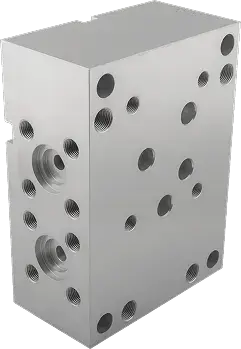
Fluid power systems use 5-axis CNC machining to produce manifolds and housings with complex internal features and tight tolerances.
Energy
Energy sector applications depend on 5-axis CNC machining for components that require complex geometry, structural integrity, and reliable performance under demanding conditions.
Why 5-Axis CNC Machining Matters
- Enables machining of complex geometries in a single setup
- Improves dimensional accuracy and surface finish
- Reduces setup time and production variability
- Supports tight tolerances and repeatable quality
- Expands what is achievable at the design stage when integrated into a lifecycle-owned manufacturing model from the start
No Matter the Industry,
We Flex to Solve What You Need
No Matter
the Industry,
We Are Part of
Everything You do.