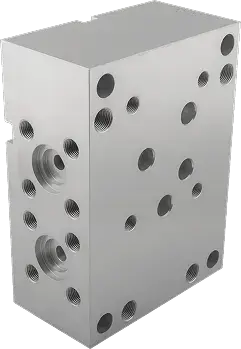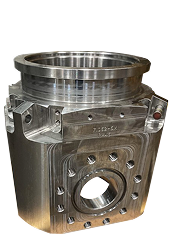

What Is CNC Machining Stainless Steel?
CNC machining stainless steel is a manufacturing process in which computer-controlled machine tools remove material from stainless steel stock to produce finished parts with high dimensional accuracy and repeatability. The process supports the production of components that require corrosion resistance, mechanical strength, and precise geometry.
Stainless steel is widely used in CNC machining because it offers excellent durability, temperature resistance, and corrosion protection across a range of industrial environments. However, stainless steel is also more difficult to machine than many other metals, requiring specialized tooling, controlled cutting parameters, and experienced process control.
In precision manufacturing environments, CNC machining stainless steel enables reliable production of parts that must perform under demanding mechanical and environmental conditions.
How CNC Machining Stainless Steel Works
The machining process follows a controlled workflow:
- Stainless steel material is selected based on grade and application requirements.
- CAD models define part geometry and tolerance specifications.
- CAM software generates machining tool paths optimized for stainless steel cutting.
- CNC machines remove material using controlled speeds, feeds, and cutting strategies.
- Finished parts are inspected to verify dimensional accuracy and surface quality.
Because stainless steel work hardens easily, careful control of machining parameters is essential to maintain tool life and part quality.
Key Elements of CNC Machining Stainless Steel
- Stainless steel grade selection based on strength and corrosion resistance
- CNC milling and turning equipment
- Cutting tools designed for stainless steel machining
- Rigid workholding and vibration control
- Controlled spindle speeds and feed rates
- Inspection and quality verification systems
Stainless Steel Machining in a Multi-Material Manufacturing Lifecycle
Stainless steel’s material properties create a set of machining challenges that make lifecycle planning particularly consequential. Unlike aluminum, stainless steel work hardens under cutting loads, meaning that poor tooling selection, incorrect feed rates, or interrupted cuts do not just reduce tool life. They change the material condition of the part itself.
A work-hardened surface is harder to machine in subsequent operations and may respond differently to heat treatment or surface finishing. Getting stainless steel machining right the first time is not just an efficiency concern. It is a material integrity concern.
Grade selection is where that challenge begins. Different stainless steel grades machine differently, and the choice of grade is rarely a machining decision alone. It is driven by corrosion resistance requirements, operating temperature, mechanical load, and compatibility with any coatings or treatments specified for the finished component.
When grade selection is made at the design stage without input from the machining and finishing stages, the result is sometimes a material that meets the performance specification on paper but creates significant process difficulty in production. Lifecycle collaboration ensures that grade selection accounts for the full production and service context, not just the design requirement.
Stainless steel components frequently appear in assemblies alongside forged or machined aluminum parts, serving as shafts, fasteners, structural inserts, or interface components. In these mixed-material assemblies, the tolerance and surface finish requirements of the stainless steel parts are defined by their relationship to the aluminum components they mate with.
Managing those interface requirements across two different materials, each with its own machining behavior and dimensional response to temperature, requires the kind of cross-stage visibility that only exists when the full assembly is considered as a lifecycle rather than a collection of individually sourced parts.
Industry Applications
Aerospace
CNC machining stainless steel supports components requiring corrosion resistance, strength, and dimensional stability in aerospace structural and mechanical systems.
Specialty Automotive
Specialty automotive applications use CNC-machined stainless steel parts for exhaust components, brackets, and structural interfaces requiring durability and heat resistance.
Motorsports
Motorsports manufacturers rely on CNC machining stainless steel for high-strength components that must withstand vibration, heat, and mechanical stress.
Heavy Equipment, Construction, and Agriculture
CNC-machined stainless steel parts provide corrosion resistance and long service life in harsh operating environments.
Fluid Power
Fluid power systems depend on CNC-machined stainless steel components for valves, fittings, and housings, requiring corrosion resistance and pressure integrity.
Energy
Energy sector applications use CNC-machined stainless steel parts for components that must perform reliably under extreme temperature, pressure, and environmental exposure.
Why CNC Machining Stainless Steel Matters
- Provides corrosion-resistant and high-strength components
- Supports tight tolerances and complex geometries
- Enables reliable performance in harsh environments
- Maintains consistent dimensional accuracy
- Requires grade selection, machining strategy, and finishing to be planned together across the lifecycle to avoid material and dimensional problems that cannot be resolved at the machining stage alone
No Matter the Industry,
We Flex to Solve What You Need
No Matter
the Industry,
We Are Part of
Everything You do.