
What Is CNC Machining?
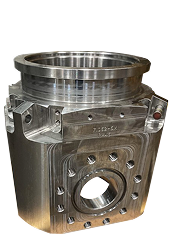
CNC machining, or Computer Numerical Control machining, is a manufacturing process in which computer software controls machine tools to remove material from a solid workpiece and produce a finished part with high accuracy and repeatability. The process follows programmed instructions derived from digital design files, allowing machines to perform complex cutting operations with minimal human intervention.
CNC machining is widely used in industrial manufacturing because it delivers consistent dimensional control, tight tolerances, and reliable part quality across both low and high volume production. The process supports a wide range of materials, including aluminum, steel, stainless steel, titanium, and specialty alloys.
In precision manufacturing environments, CNC machining translates a component’s underlying structural properties into functional geometry, establishing the tight tolerances, surface conditions, and interface features required for real-world performance.
How CNC Machining Works
CNC machining follows a structured digital workflow:
- A CAD model defines the part geometry.
- CAM software converts the model into machine-readable code.
- The CNC machine interprets this code to control spindle speed, feed rate, tool position, and cutting depth.
- Cutting tools remove material to form the final shape.
- The finished part is inspected to verify dimensional accuracy and quality compliance.
This automated control allows CNC machines to reproduce identical parts with minimal variation.
Key Elements of CNC Machining
- CNC Machine Tools: Milling machines, lathes, and multi-axis machining centers.
- Control System: The computerized interface that executes machining instructions.
- Cutting Tools: End mills, drills, inserts, and specialty tooling.
- Workholding: Fixtures and clamps that secure the workpiece.
- Programming: CAM-generated tool paths and machining parameters.
- Inspection: Measurement systems that verify dimensional accuracy and surface finish.
CNC Machining Within the Manufacturing Lifecycle
In an end-to-end manufacturing model, CNC machining functions as a precision refinement stage, not the origin point of a component’s quality. The decisions made earlier in the lifecycle, including material selection, forming method, and near-net shape strategy, directly determine what machining can achieve and how efficiently it can do so.
When upstream processes produce consistent, well-characterized incoming geometry, machining can focus on refining tolerances, creating functional interfaces, and achieving the surface conditions required for sealing, mating, or assembly. When upstream variation is high, machining is put in the position of compensating for problems it cannot fully correct.
This is why lifecycle alignment matters. A part that arrives at the machining stage with predictable geometry, stable material properties, and documented process history is fundamentally easier to machine to specification, with less scrap, less rework, and more consistent results across a production run.
Tolerance stack-up is one of the clearest examples of what happens when machining is treated as an isolated operation. If the forming stage and the machining stage are not aligned on datum points and tolerance assumptions from the start, a part can technically pass inspection at each stage but still fail to function correctly in final assembly. Lifecycle ownership prevents this by ensuring that tolerances are assigned and managed across the full process, not just within individual operations.
CNC machining also plays a direct role in supporting prototype-to-production continuity. When machining is part of a coordinated lifecycle rather than a separate contracted operation, the process parameters, fixturing, and tooling strategies developed during prototyping carry forward into production in a controlled way. This reduces the risk of performance variation between development and volume production.
Dimensional inspection throughout the machining process, not only at final check, is a core part of lifecycle-owned manufacturing. Verifying geometry at each stage ensures that out-of-tolerance conditions are caught before additional processing cost is added.
Industry Applications
Aerospace
CNC machining is essential for producing aluminum components used in airframes, structural systems, and mechanical assemblies where tight tolerances, surface integrity, and repeatability are mandatory for safety and certification compliance.
Specialty Automotive
In specialty automotive manufacturing, CNC machining supports complex geometries, lightweight design requirements, and precision fitment for performance-oriented components such as suspension systems, braking components, and structural brackets.
Motorsports
Motorsports applications rely on CNC machining for rapid production of high-precision aluminum parts where weight reduction, dimensional accuracy, and repeatability directly impact performance and reliability under extreme operating conditions.
Heavy Equipment, Construction, and Agriculture
CNC machining ensures dimensional consistency and durability for components used in heavy-duty machinery, agricultural equipment, and construction systems where strength, alignment, and long service life are critical.
Fluid Power
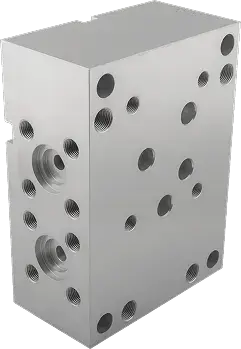
In fluid power systems, CNC machining produces precise hydraulic and pneumatic components such as valve bodies, housings, and connectors that require tight tolerances to maintain pressure control and system efficiency.
Energy
Energy sector applications depend on CNC machining for components used in oil, gas, and power generation systems, where material integrity, accuracy, and traceability are essential for operational safety and reliability.
Why CNC Machining Matters
- Delivers high-dimensional accuracy and repeatability
- Supports complex geometries and tight tolerances
- Enables efficient production across volume ranges
- Provides consistent surface finishes and part quality
- Supports controlled and traceable manufacturing processes
No Matter the Industry,
We Flex to Solve What You Need
No Matter
the Industry,
We Are Part of
Everything You do.