

The Ultimate Guide to Custom Forging: Alloys, Forging Techniques, and More

Custom forging is a manufacturing process in which metal is shaped under controlled pressure to produce components with improved grain flow, structural integrity, fatigue resistance, and durability. Closed die forging is especially valuable for repeatable production of complex, high-strength components. The success of a forging program depends on how well alloy selection, part geometry, tooling, forming, heat treatment, machining, and inspection work together.
Introduction
Sourcing a forged component requires more than sending a drawing to a forging company and requesting a quote.
Many decisions that affect performance, consistency, and total cost are made before the first billet is heated. Manufacturers must select the right alloy, ensure the geometry supports proper material flow, choose the appropriate forging method, and determine machining, heat treatment, inspection, and scalability requirements.
Custom forging is therefore an engineering-driven manufacturing process, not simply a metal-shaping operation.
This guide explains how custom forged components move from material and design selection through tooling, forming, heat treatment, machining, inspection, and delivery.
What Is Custom Forging?
Custom forging uses compressive force and purpose-built tooling to shape metal into a component designed for a specific application. Unlike standard commodity forms, each forging is engineered around the part’s functional, structural, and dimensional requirements.
Tooling is created around the component geometry, while material flow is planned to support expected load paths. Alloy, temper, tolerances, machining allowances, secondary operations, inspection, and traceability requirements are also built into the manufacturing plan.
Because each stage affects the next, custom forging is strongest when engineering, tooling, forming, heat treatment, machining, inspection, and supply chain planning are managed together. This is where an integrated manufacturing partner can reduce handoffs, improve accountability, and help customers make better decisions before production begins.

How Forging Changes the Internal Structure of Metal
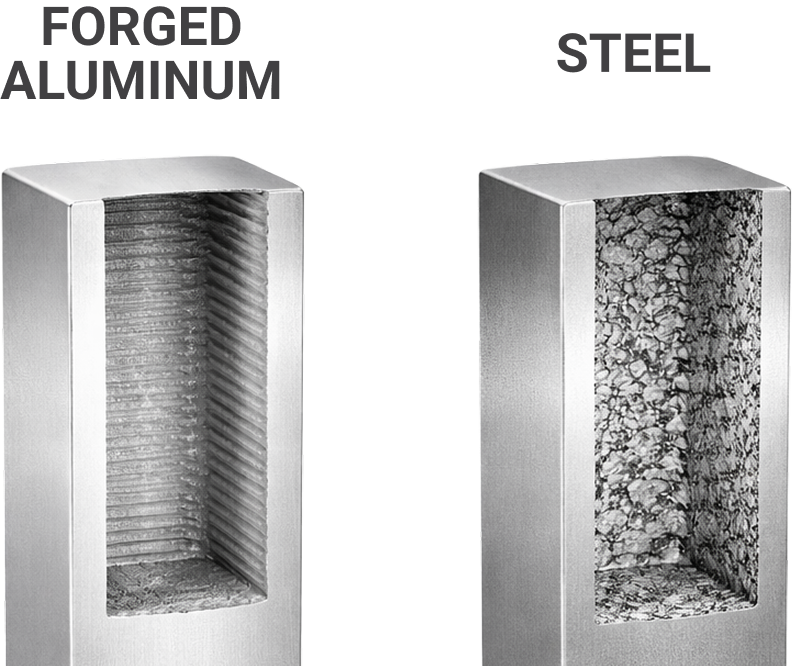
A key benefit of forging is its effect on grain flow.
During forging, plastic deformation causes the metal's grain flow to follow the contours of the finished part rather than being interrupted, as it would be with machining from bar or plate stock. This continuous, directional grain flow improves fatigue resistance and impact strength by aligning the material's inherent strength with the component's geometry and expected loads. Forging temperature, deformation history, and any subsequent heat treatment separately determine the part's microstructure, including grain size and phase distribution, which further influences mechanical performance.
Machining from billet removes material to create the final shape and may cut across the existing grain structure. However, forging does not eliminate machining. Many high-performance parts use a forged blank for strength and CNC machining for bores, threads, sealing surfaces, and other tight-tolerance features.
Why Manufacturers Choose Custom Forged Components
Custom forged components can provide:
- High strength-to-weight performance
- Improved fatigue and impact resistance
- Reduced porosity compared with many cast parts
- Consistent structural properties
- Repeatability across production runs
- Lower material waste through near-net-shape designs
- Scalability for ongoing production
- Suitability for demanding or safety-critical applications
Forging is not the best choice for every component. The right process depends on the part’s geometry, alloy, production volume, tolerances, tooling budget, lead time, and performance requirements. Complex low-volume parts may suit another process, while high-strength components produced repeatedly at scale may be strong candidates for closed die forging. Learn about custom forging solutions.
The Custom Forging Process From Concept to Finished Component

A custom forging program typically moves through a connected series of engineering and manufacturing stages:
- Application and performance review
- Alloy selection
- Design for manufacturability review
- Forging simulation and process planning
- Tool and die design
- Billet or stock preparation
- Heating
- Preforming and final forming
- Trimming
- Heat treatment
- Cleaning and finishing
- CNC machining
- Inspection and validation
- Assembly, packaging, and delivery
These steps are interdependent. A decision made during alloy selection can affect heating temperatures, die design, forming pressure, heat treatment, machining, and inspection. A change to part geometry can alter material flow, flash formation, tooling requirements, and the amount of stock available for final machining.
The strongest custom forging programs evaluate the full manufacturing lifecycle before production begins.
Engineering and Design Review
Engineers review draft angles, parting lines, radii, wall thickness, rib geometry, load paths, machining allowances, tolerances, flash placement, material flow, and inspection access.
A strong forging partner should identify features that could cause incomplete die fill, laps, folds, excessive flash, distortion, or unnecessary machining before tooling and production begin.

Tool and Die Development
Tooling directly affects final geometry, material flow, repeatability, surface finish, flash formation, tool life, production rate, and unit cost.
An in-house tool and die shop can make it easier to adjust tooling as production requirements evolve, helping reduce delays and maintain greater control over the manufacturing process.
Custom Forging Techniques Explained
The techniques below reflect common approaches used across the forging industry. Anchor Harvey specializes in press-based closed-die aluminum forging; the other methods are included here for general context.
Forging methods differ according to how the material is constrained, how force is applied, and how closely the forged part resembles its final geometry.
Closed Die Forging
Closed die forging, also called impression die forging, forms heated metal between shaped dies. As the dies close, the material flows into the impressions and takes the geometry of the tooling.
This method is well suited to complex, repeatable, high-strength components. It can provide controlled grain flow, good dimensional consistency, and efficient production once the process and tooling have been established.
Anchor Harvey specializes in closed die aluminum forging for precise components used in demanding applications.
Open Die Forging
Open die forging shapes metal between flat or relatively simple dies that do not completely enclose the workpiece.
The operator or equipment manipulates the material between forming operations until the desired shape is achieved. Open die forging is commonly used for larger, simpler forms, low-volume components, and preforms.
Because the tooling does not closely define the final geometry, open die forgings generally require more downstream machining than closed die components.

Flashless Forging
Flashless forging uses tightly controlled material volume so the die fills without producing excess flash around the parting line.
The process can reduce material waste and eliminate some trimming operations. However, it requires precise billet volume, tooling, temperature control, and process consistency. Too little material can leave the die incomplete, while too much can create excessive pressure.
Near Net Shape and Net Shape Forging
Near net shape forging produces a component close to its final dimensions. Only a limited amount of material remains for machining or finishing.
Net shape forging produces a part at or extremely close to its final geometry, with little or no machining required for certain features.
Both approaches can reduce scrap, machining time, cutting tool wear, and total production cost. Their feasibility depends on component complexity, tolerance requirements, material behavior, tooling, and production volume.
Press Forging Versus Hammer Forging
Press forging applies force through a controlled ram stroke. Mechanical, screw, and hydraulic presses each deliver that force differently, but all produce a controlled, progressive deformation of the material.
Hammer forging uses repeated impact blows to form the metal. It can shape material quickly and is suitable for a range of component sizes and geometries.
The correct method depends on the alloy, part shape, equipment, production requirements, and desired material flow.
Choosing the Right Alloy for a Custom Forging
Material selection should begin with application requirements, not a preferred alloy number.
Engineering and sourcing teams must consider strength, fatigue and impact performance, weight, corrosion resistance, temperature exposure, machinability, heat treat response, availability, cost, and certification requirements.
The best alloy is not always the strongest. It should meet performance needs while supporting reliable forging, machining, heat treatment, and long-term production.
Aluminum Alloys for Forging
Aluminum is widely used for forged components because it combines low weight, corrosion resistance, forgeability, machinability, and heat treatability. It is especially useful when weight reduction cannot compromise strength or fatigue performance.
2000 Series Aluminum
The 2000 series offers high strength and good fatigue performance, making it common in aerospace and other demanding applications. Because corrosion resistance may be lower than with some other aluminum families, protective finishes may be required.
6000 Series Aluminum
The 6000 series provides good corrosion resistance, machinability, heat treatability, and moderate to high strength. It is used across a wide range of industrial applications.
7000 Series Aluminum
The 7000 series includes very high-strength alloys used in aerospace, defense, and other performance applications. These materials require careful process and heat treatment control, particularly where stress corrosion is a concern.
Magnesium Forging
Magnesium offers very low weight and strong strength-to-weight performance, making it attractive for aerospace, defense, motorsports, and mobility applications.
Anchor Harvey is developing its magnesium forging capabilities through prototype and testing work. Manufacturers should confirm current availability, material options, and validation requirements with its engineering team.
Steel, Titanium, and Other Forging Alloys
Custom forging may also involve carbon steel, alloy steel, stainless steel, titanium, nickel-based alloys, and copper alloys. Each requires different forging temperatures, tooling, heat treatment, and machining controls.
Anchor Harvey’s primary forging specialization is aluminum, although its broader manufacturing network can support additional materials through machining and qualified partners.
Heat Treatment and Its Role in Forged Component Performance
Forging establishes a component’s shape and grain flow, while heat treatment develops the mechanical properties required for the application.
Depending on the alloy and specification, heat treatment can increase strength and hardness, stabilize the microstructure, improve dimensional stability, achieve the required temper, and prepare the part for final machining or finishing.
Because heat treatment can affect dimensions and performance, it should be planned alongside forming, machining allowances, and inspection.

T4 and T6 Aluminum Tempers
T4 aluminum is solution heat treated and naturally aged. It may be used when additional forming is required or when a specific balance of properties is needed.
T6 aluminum is solution heat treated and artificially aged. It is commonly selected for higher strength and more predictable mechanical properties.
Other tempers are used depending on the alloy and application. For example, overaged 7xxx tempers such as T73 and T74 trade some strength for improved resistance to stress corrosion cracking, which matters in high-strength aluminum forgings exposed to sustained loads or corrosive environments.
Anchor Harvey offers T4, T6, and other temper options as part of its integrated forging process.
Why In-House Heat Treatment Matters
In-house heat treatment reduces supplier handoffs and improves scheduling, traceability, documentation, and corrective action. It also helps align forming conditions with final mechanical properties while reducing transportation and queue time.
Anchor Harvey integrates heat treatment into its production lifecycle and describes its system as CQI-9 compliant. Its process is also designed to meet or exceed applicable ASTM requirements.
Forging Defects and How Process Control Prevents Them
Forging defects are often associated with material flow, billet volume, temperature, tooling condition, deformation, cooling, or heat treatment.
Common examples include incomplete die fill, laps, folds, cracking, excessive flash, die mismatch, and distortion following heat treatment.
Incomplete fill can occur when material does not flow into every area of the die. Laps and folds may develop when material flows over itself instead of joining correctly. Cracking can result from unsuitable temperatures, excessive deformation, geometry, or material condition.
Flash and mismatch problems may be tied to billet volume, die alignment, wear, or tooling condition. Distortion can occur when parts cool or respond to heat treatment unevenly.
Forging simulation, controlled billet preparation, temperature monitoring, in-house tooling, process inspection, documented heat treatment, and corrective action systems all help reduce defect risk.
The correct manufacturing process depends on what the component must do, how it is shaped, how many parts are needed, and how much variation the application can tolerate.
Machining from billet removes material from solid stock until the final shape is produced. Extrusion pushes material through a die to create a continuous profile. Casting pours molten material into a mold.
Each process offers advantages, but they produce components in fundamentally different ways.

Forging Versus Machining From Billet
Machining from billet can produce complex details and extremely tight tolerances. It is often valuable for prototypes, low-volume components, and features that cannot be formed directly.
However, machining removes material and may cut through the existing grain structure. It can also generate considerable scrap when a large billet must be reduced to a smaller finished component.
Forging directs grain flow around the part and can reduce material waste at production scale. Many effective manufacturing programs combine a near net shape forging with CNC machining.
The forging provides the structural foundation. Machining adds precision bores, threads, datums, mounting surfaces, and other functional interfaces.
Forging Versus Extrusion
Extrusion is ideal for long products with a consistent cross section, such as rails, tubes, channels, and structural profiles.
Forging supports three-dimensional components with changes in thickness, direction, and geometry. It is often better suited to structural parts with complex load paths that cannot be created through a continuous extrusion profile.
Extrusions can still serve as useful starting material for certain machined components. The decision depends on whether the part requires a consistent cross section or a purpose-built three-dimensional structure.
Forging Versus Casting
Casting pours molten material into a mold, which allows complex shapes and internal cavities that would be difficult to forge. It can also be efficient for high-volume production of intricate geometries.
However, the casting process can introduce porosity as the material solidifies, which may affect fatigue performance and structural reliability in demanding applications. Forging works the material in its solid state, producing a denser part with fewer internal voids and grain flow that follows the component's geometry. This makes forged parts better suited to applications with high stress, cyclic loading, or safety-critical requirements.
Aluminum Forging Process Checklist
Before requesting a quote, engineering and sourcing teams should review the following questions.
Application Requirements
- What loads will the component experience?
- Are the loads static, cyclic, impact-based, or combined?
- What fatigue life is required?
- Will the component operate in a corrosive environment?
- What temperatures will it experience?
- Is weight reduction a major objective?
- Is the component safety-critical?
Alloy and Temper
- Was the alloy selected according to application performance?
- Is the material suitable for forging?
- Does it support the required temper?
- Are corrosion protection or coating requirements defined?
- Are material certifications and lot-level traceability required?
Geometry and Tooling
- Has the part received a forging manufacturability review?
- Are draft angles and fillet radii appropriate?
- Are wall thickness transitions gradual?
- Is the parting line positioned correctly?
- Can the component be produced near net shape?
- Are machining allowances clearly defined?
- Who owns, maintains, and replaces the tooling?
- Can tooling modifications be completed in-house?
Heat Treatment, Machining, and Finishing
- Which temper is required?
- How will heat treatment distortion be managed?
- Which features require CNC machining?
- Which tolerances are truly critical?
- Are threads, bores, sealing surfaces, or mounting interfaces required?
- Are anodizing, coatings, blasting, polishing, or other finishes needed?
Quality and Production
- Is first article inspection required?
- Are PPAP, FAI, nondestructive testing, or mechanical testing required?
- Which dimensions are critical to quality?
- How will traceability be documented?
- What certifications apply?
- What is the expected annual production volume?
- Are prototype, stocking, Kanban, consignment, or min and max programs needed?
- Can the supplier scale while maintaining the approved process?
Building a Successful Custom Forging Program
Successful custom forging requires alignment across material, geometry, tooling, forming, heat treatment, machining, quality control, and supply planning.
Considering forging early can improve grain flow, reduce material waste, simplify machining, and lower total cost. Closed die forging is especially well suited to repeatable, high-strength parts.
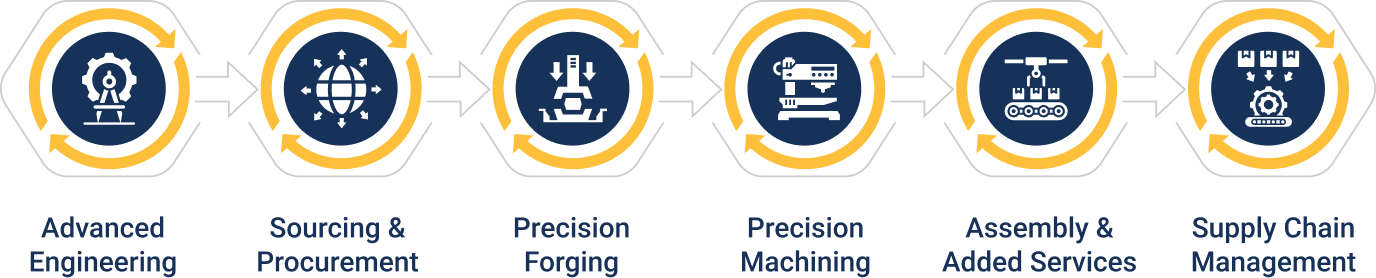
The right supplier should support more than production. Anchor Harvey’s End-to-End Solution™ brings engineering, forging, heat treatment, CNC machining, quality, and supply chain support together within a more connected manufacturing process.
Talk to Anchor Harvey about a custom forging program built to support your component from early engineering through production and delivery.