


Lessons from Europe: Why End-to-End Manufacturing Is Gaining Ground in the U.S.

Summary
As U.S. manufacturers navigate a landscape of shifting tariffs and rapid AI adoption in 2026, many are looking toward European models to build resilience. By consolidating fragmented supply chains into a single end-to-end partner, domestic OEMs can reduce administrative overhead and accelerate their design cycles.
Key Takeaways
- Supply Chain Resilience: End-to-end models minimize the logistics risks and lead-time spikes caused by global volatility.
- Reduced Complexity: Consolidating vendors allows OEMs to focus on high-level system design rather than managing many individual part suppliers.
- Quality Control: Keeping forging, machining, and finishing under one roof reduces tolerance stack-up and improves traceability.
- Cost Efficiency: Strategic vendor consolidation can reduce downtime and lead to significant savings in the total cost of ownership.
For decades, the standard process for many U.S. manufacturers was a distributed, fragmented supplier model. An Original Equipment Manufacturer (OEM) might source a raw forging from one state, ship it to another state for precision machining, then send it to a third location for a specialized treatment or coating; or even more facilities beyond this.
This approach creates a complicated logistical network that's expensive to manage, vulnerable to supply chain and transportation issues, and prone to too much quality variability.
That's why many industries are taking a different path. Driven by the supply chain shocks of the early 2020s and the mounting pressures of current economic factors, like tariffs, more and more American organizations are adopting a new philosophy from their European counterparts: end-to-end manufacturing.
The Traditional U.S. Manufacturing Model
The legacy U.S. model often prioritized a fragmented approach where manufacturing processes such as forging, machining, finishing, and assembly were split across multiple vendors. In a simpler era, this model was manageable and economically advantageous. But as global supply chains have become more complex and labor shortages have intensified, the hidden costs of this model have significantly added up.
Plus, every handoff between suppliers presents a potential failure point. It's another order to track, another shipping window to coordinate, and another layer of quality inspection to perform. For mid-market OEMs, this administrative burden gets draining. It pulls engineering and procurement resources away from product innovation and creates slowdown.
The European Manufacturing Model: A Culture of Integration
While the U.S. diversified its manufacturing process, Europe took a different approach. Countries like Germany, Italy, and Switzerland doubled down on vertical integration, or more broadly end-to-end manufacturing (E2E).
This approach has deep roots, tracing back to the 19th century industrial revolution when manufacturers consolidated processes like casting, forging, and finishing to reduce dependency on external variables.
In modern Europe, this philosophy is best seen in action in Germany's Mittelstand, the mid-sized manufacturers that form the backbone of the German economy. These companies often maintain a self-sufficient production footprint, keeping multiple manufacturing stages under a single roof.
Bosch is one example of a global leader in this approach. In their fuel rail production, they manage everything from steel forging to heat treatment, machining, and final assembly. This level of process ownership ensures that every step is optimized for the next. It streamlines the supply chain and reduces the logistical "bloat" that often plagues fragmented models.
What End-to-End Manufacturing Actually Means
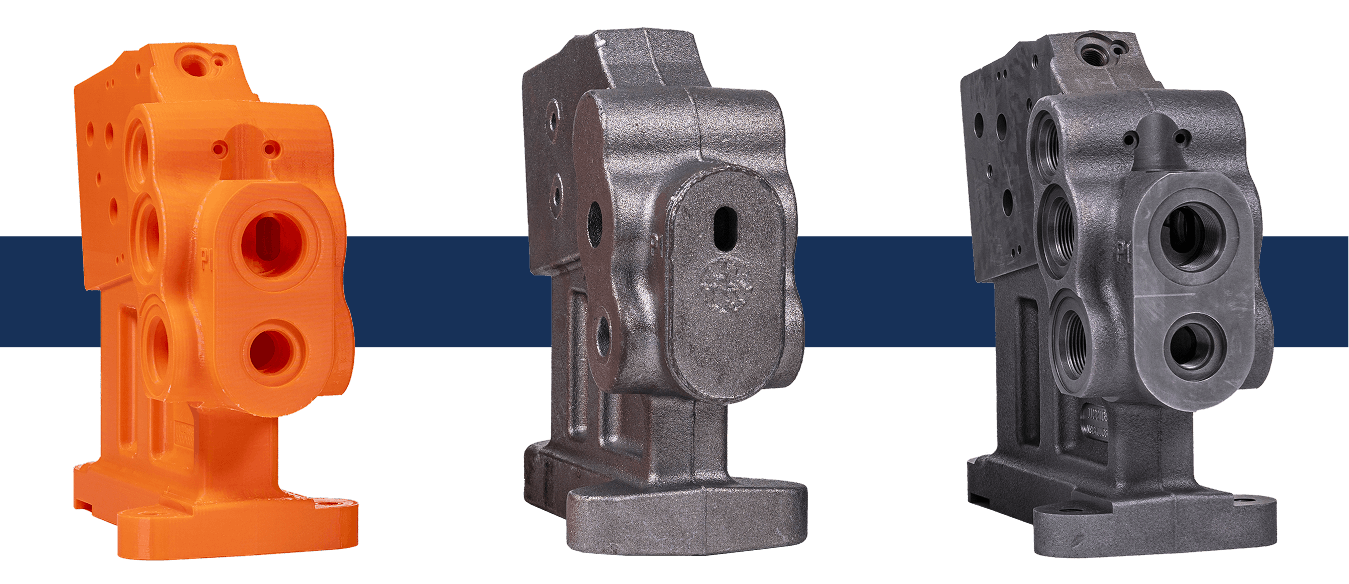
As the success of the European model proves, end-to-end manufacturing is more than a buzzword. It's a shift from a vendor-component relationship to a true manufacturing partnership. In E2E models, a single partner manages the entire component lifecycle. This includes everything from initial engineering collaboration and material sourcing to the final finished assembly, and future product iterations. While vertical integration focuses on physical production, end-to-end manufacturing extends across the full product lifecycle, including pre- and post-production services.
Instead of receiving a raw part that requires further processing, the OEM receives a completed, high-precision component that's ready for the assembly line. It moves the burden of process coordination, defect control, and sub-assembly management away from the OEM and onto the specialist supplier.
Why the Model Works: Efficiency by Design
What makes E2E manufacturing so effective? It's grounded in measurable data. Research about manufacturing environments shows that vertical integration preserves productivity that's often lost when steps like heat treatment or finishing are outsourced.
Key benefits of an integrated E2E manufacturing approach include:
- Reduced Tolerance Stack-Up: When the same team that forges a part also machines it, they have a deeper understanding of how the material behaves, leading to tighter tolerances and fewer defects.
- Operational Gains: Integrated data systems across forging and machining can lead to an 8-12% improvement in throughput and a 10-15% reduction in scrap.
- Capacity Optimization: Supports both operational and production scalability by reducing internal coordination burden and expanding access to manufacturing resources, enabling growth without immediate investment in additional equipment or headcount.
- Faster Iteration: Both engineering and manufacturing teams can collaborate in real-time, shortening lead times and accelerating the design-to-production cycle.

Why the U.S. Is Moving in This Direction
In 2026, several factors are converging to make end-to-end manufacturing a strategic imperative for domestic OEMs.
First, there's "expertise shift." Many American OEMs are listing their internal functional expertise in specialized processes like forging or casting. As veteran engineers retire, these companies are finding it more difficult to rely on Tier 1 suppliers (the true process experts).
Secondly, there's a clear mandate to reduce headcount and complexity. Many major industrial organizations have set goals to drastically reduce their supplier base. But they're not just doing this to bring production in-house. They're seeking multi-capacity partners who can do more from a single point of contact.
Finally, the focus of many U.S.-based OEMs has changed. Today, more and more industry leaders are prioritizing AI-powered autonomy and high-level system design. By offloading physical component manufacturing to an E2E player, they can redirect their capital and talent toward other technologies that will define the next decade of industrial manufacturing leadership.
Real-World Examples of E2E Success
We see this play out, in real-time, across several diverse industries:
- Agriculture: A commodity manager at a U.S.-based agricultural market leader recently tasked their team with reducing 200 suppliers down to just 7. By selecting Anchor Harvey for both casting and machining services, they significantly reduced the complexity of their procurement workload.
- Safety-Critical Systems: For over 20 years, a global industrial and materials science company has relied on Anchor Harvey for raw forgings. That partnership has since expanded to include both forging and precision machining for a safety-critical firefighting breathing apparatus. This partnership allows the customer to avoid capital investment in-house while receiving a more complete, high-quality component.
- Defense and Infrastructure: Requirements for reshoring are driving defense contractors to seek domestic E2E partners who can ensure full traceability and security for critical components.

The Anchor Harvey End-to-End Solution™
At Anchor Harvey, we've spent years evolving our capabilities to meet the growing demand for integrated solutions. We're not just a component vendor; we're a strategic manufacturing partner capable of managing the full metal component life cycle.
Our approach combines engineering collaboration with integrated design and engineering, forging, machining, supply chain coordination, assembly, packaging, shipping, and more. By bringing these processes under one roof, we provide our clients with more benefits than a vertically integrated in-house operation, without the massive capital requirements.
This allows you to focus on what you do best: designing the complex systems that power the world.
Want to learn more about end-to-end manufacturing with Anchor Harvey? Contact us today!